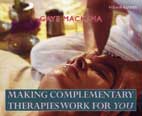




making
complementary therapies work
for you

gaye mack

mctw

There any many reasons for seeking to supplement conventional treatment, but the massive array of complementary therapies is bewildering. This is a book designed to make the choice of complementary therapy simpler, and to enrich the patient-healer relationship.

It begins by outlining the fundamental truths on which most therapies are based. One thing that all complementary therapies have in common is a much greater involvement in our own recovery. Most of them return to levels of doctor-patient involvement that have been lost.

The main classes of treatment are broken down into four 'families': the Chinese system, which includes acupuncture and herbal medicine; the Indian or Ayurvedic system, ranging from nutrition to yoga; Western 'subtle' systems such as homeopathy; and communicators between body, mind and spirit like the flower essences.

MAKING Complementary THERAPIES WORK FOR YOU is also a vital aid for physicians wishing to introduce patients to new treatments and for therapists seeking to reassure their clients and aid their recovery. It is not however a directory so much as a simple guide to participation. This book will help any user of complementary therapies to understand them better. The individual's response to the therapy will be more in tune with the body's own intelligence.

Gaye Mack's own speciality is the Bach Flower Remedies, but her MA thesis was on the treatment of eating disorders, so she understands well both the viewpoint of the medical profession and that of the complementary practitioner. She is the author of another Polair title, IGNITING SOUL FIRE.

Autumn 2005
64 pages, line illustrations
178 x 144 mm landscape, paperback
ISBN 1-905398-07-7
UK£6.99 - US$12.95

REVIEWS:

Useful overview of many of the most common complementary therapies, enabling one to make a more informed choice.

Yoga and Health

As books on complementary therapies go, this is a very unusual one. It focuses on the importance of body, mind and spirit working in harmony, both internally, between aspects of one's own being, and externally with the surrounding environment and nature. It emphasises our need to recognise our own spiritual divinity. We are spirit in body, and to participate in the process of manifesting our highest purpose we must listen with our soul wisdom and our intuition. Internal harmony with our Divine Self and the external harmony or universal connection is an ideal for all humanity.

Illness is the result of disharmony between our intended life-path as determined by our individual soul and personality. Among other things, it may be caused by emotional difficulties, life style, diet or stress. The book considers four therapies that can help restore harmony: traditional Chinese medicine, Ayurvedic medicine, homeopathy and flower remedies. There is a chapter on each which gives a description of the philosophy behind it, what the therapy involves and what to expect on visiting a practitioner. The chosen therapies all have the common theme of using nature's resources to assist healing of the body, mind, emotions and spirit. Active participation in the healing process is encouraged in each therapy. This small book has a huge content. Not only does it provide factual information in a clear, concise form on the four therapies, it also stimulates consideration of the need for harmony between all parts of our being and the Divine.

P. G., in 'Stella Polaris' (White Eagle magazine)

This short book is a very useful introduction to the principles and philosophy of complementary therapies in general, highlighting the importance of such concepts as energy and balance and showing how the therapies can lead to greater integration of the levels of our being. The first two chapters give background material and are followed by four individual chapters on TCM, Ayurvedic medicine, homeopathy and Bach Flower remedies. The explanations are clear and succinct, with summaries at the end. By the end of the book the reader will have a much better feel for the field and be able to judge which approach may help in their individual case.

Scientific and Medical Network Newsletter

Searching for a guide to alternative therapies? Then Chicago-based writer Gaye Mack?s second title from Polair Publishing, Making Complementary therapies Work for You, might just be the perfect pick. In this volume, Mack takes a quick look at the history of alternative therapies, their spiritual roots and the Western world?s continued reluctance to embrace them.

Condensing a variety of alternative therapies into four major groups, Mack provides and introduction to Chinese, Indian and Western systems, as well as to the Bach Flower Remedies. Topics such as acupuncture, yoga and even homeopathy are discussed. In keeping with the idea of serving as a guide for her readers, Mack finishes each chapter with a box filled with key points from the chapter. Mack concludes with a suggested list for further reading, stressing that her guide is only the beginning and that there is much more to be learned.

Conscious Choice


Polair Publishing